Hoi An Town is an exceptionally well preserved example of a Southeast Asian trading port dating from the 15th to the 19th century. Its buildings and its street plan reflect the influences, both indigenous and foreign, that have combined to produce this unique heritage site.
Tả về thành phố đà lạt bằng tiếng anh, Viết đoạn văn ngắn về đà lạt bằng tiếng anh, Món ăn đà lạt bằng tiếng anh, viết đoạn văn bằng tiếng anh về kỳ nghỉ hè ở đà lạt, giới thiệu về đà lạt, kể về chuyến đi đà nẵng bằng tiếng anh, miêu tả chuyến đi đà lạt bằng tiếng anh.
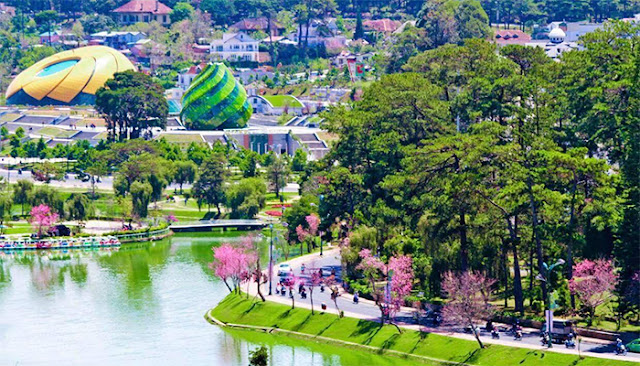
The name “Đà Lạt” combines “Đà,” which originates from “Đak" and means “water” or lake in the local dialect, and “Lát,” the name of the local ethnic-minority group, a subsection of the Cơ Ho group. The name “Đà Lạt” thus refers to the water of the Lát (Lách) people. Đà Lạt is home to many beautiful lakes, making it a popular spot for travellers. The city has seen an influx of tourists in recent years because of the international popularity of ecotourism. Now, the city is among the top ten tourist destinations in Việt Nam. Climbing Lang Biang Mountain just north of Đà Lạt and the many walking tracks surrounding the city are popular with both residents and tourists.
Situated right in the heart of Hochiminh City is the most famous landmark as well as core Cathedral of the city, Saigon Notre-Dame Cathedral (translated as “Nhà thờ Đức Bà Sài Gòn).
Notre-Dame Cathedral, or Notre-Dame Basilica to be exact, is a famous age-long cathedral in Southern Vietnam. It is a magnificent building located at the paris Square in Ho chi minh City downtown, attracting not only Catholics but also most tourists for its neo-Romanesque style architecture and a sacred atmosphere.
My Son, located 69 km southwest of Danang, was an imperial city during the Cham dynasty, between the 4th and 12th centuries. My Son Sanctuary is a large complex of relìgious relics that comprises more than 70 architectural works. They include temples and towers that connect to each other With complicated red brick designs. The main component of the Cham architectural design is the tower, built to reflect the divinity of the king.
Situated in the North-East region of Vietnam, Halong Bay is a bay in the Gulf of Tonkin comprised of regions of Halong City, the township of Cam Pha, and a part of the island district of Van Don. Halong Bay borders Cat Ba Island in the southwest, the East Sea in the east, and the mainland, creating a 120 km coastline Halong Bay is made up of 1,969 islands of various sizes, 989 of which have been given names.
Subscribe to:
Posts (Atom)